

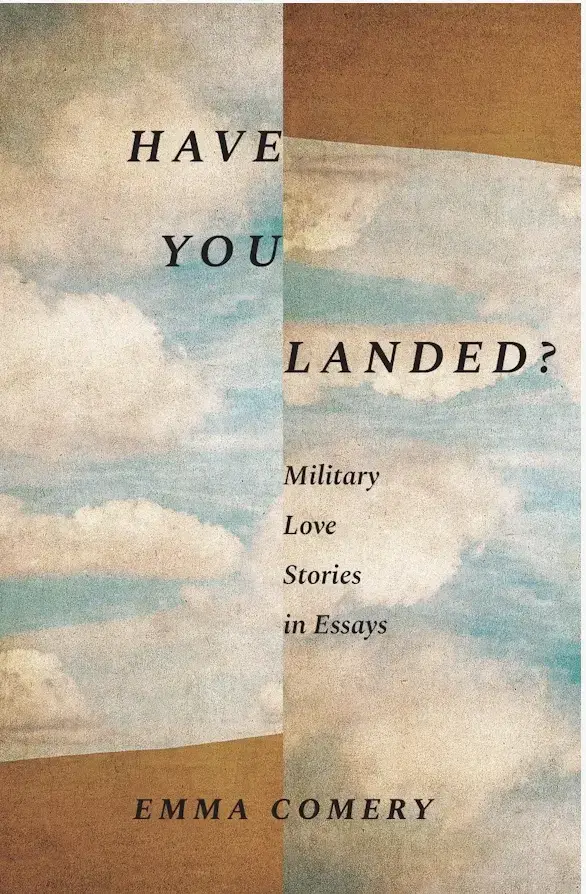
In her debut work of nonfiction, writer Emma Comery — military spouse and powerhouse essayist — tackles the complex realities of marrying into the military. Her book “Have You Landed?” is a collection of finely drawn portraits spotlighting people who fell in love with service members and then had their lives upended in ways often wholly unfamiliar to the general public: being caught in a foreign riot, alone in the aftermath of a catastrophic earthquake, quietly navigating how to build a home halfway across the world from everyone else you love.
Praised by “Southern Living” and in literary spaces alike, Comery beautifully conveys the nuances of life as a military spouse — the occasional reluctance, the forced resilience, the underpinning of love that makes the whole wild experience extraordinary. Woven alongside the portraits of other spouses are stories from Comery’s own experiences of life inside and alongside service, and what serving one’s country means from the perspective of a spouse.

Comery spoke with Military Families Magazine contributor and longtime friend Kate Lewis about her work, words and what she learned when she went in search of, as she put it, “where the wives are” in the broader stories of military life.
























Q&A with the author
This interview has been condensed for clarity.
What felt like the inspiration for this book, to me, came on page 111: “I am interested in what lies outside the margins of the news reports and the military files. I am interested in where the wives are.” I’d love to hear your thoughts on what you hoped to learn about where the wives are, and what you did discover through your interviews.
The idea for this book was born — probably like many books — from frustration that one like it didn’t already exist. I became a military partner after the community experienced a bit of a cultural shift. A generation or even half generation ago, there was a lot more formalized support for the spousal community and families. That was back when there was a more formalized expectation of spousal involvement and their unpaid service. Military spouses weren’t working, and they were pretty much all female. Today we have a much more diverse spousal community, and a lot of us are working. So the bandwidth for formalized support and community-driven resources isn’t there in the same way. So we have to find other ways to support each other and pass on that hard-earned wisdom and learned experience to newer members of the community. I wanted a book that did that in a literary way.
During the pandemic, my husband was deployed and I never met a single person attached to his ship. I literally had no idea where the women were. But I knew they weren’t sitting around and waiting. When in the course of history have women ever sat around and waited? I was so intrigued by how other military spouses might have navigated the loneliness and anxiety and independence and self-discovery that comes with time apart from your other half. So I went into the project sort of focusing on that deployment survival part but as I began to interview partners from across the military, the project expanded into an exploration of all the topics that they brought up in our conversations — separation, yes, but also grief and risk and fidelity, childrearing, career changes, identity, mental health. So the book grew from a microscope slide of one particular military life experience into a social portrait that explores universal experiences within the microcosm of military life. It’s a book about military partners, but I think there are themes and discoveries within it that will feel familiar to all of us, military or not.
I’d love to hear more about the interviews! What was the process like to find these spouses and could you share a bit about how they shared with you?
It was scary and emotional and amazing. I was terrified that no one would want to let me interview them. I just put out a social media post saying I was looking for folks to share their story, and I was honestly shocked when I got over 60 responses. I wanted a good spread of representation across branches, active duty versus reservists, officer versus enlisted, etc. Most of the interviews were over Zoom, although some people were close enough that I could drive to them and take them out to dinner, which was really fun. The interviews were done over time.
Most folks did three interviews. A few I asked for more time with them, and some I simply was able to send some quick follow-up questions via email throughout the writing process. Sometimes I just wanted to ask what color their house was. But other times I asked them to walk me through a scene from their memory with as much detail as possible — a trick learned from Anne Lamott. But I didn’t really need to pull much out of people, they were by and large really forthcoming, which was incredible. My background in doing profile articles for magazines gave me a lot of interviewing tricks, but I didn’t need to use them a lot for this project. They saw a need for this kind of storytelling and they wanted to offer their experiences as a source of comfort, education, and community.
This book is truly built from the collective generosity of strangers. There were many times when I logged off of an interview just in tears because of what people shared with me. The conversations could be really intense, and they could also be hilarious and sometimes just feel like having coffee with a friend. One woman told me she thought of our conversations as a sort of therapy because I was asking questions that no one else asked her, and then I just listened for hours. Selfishly, I really loved getting to know all of these people who I never would’ve met otherwise, and I’ve been able to stay in touch with so many of them, and hear all about the subsequent chapters of their stories.
The subtitle of “Have You Landed?” is “Military Love Stories in Essays” — and the book explores what it’s like to love a service member in all its complex, complicated ways. How do you see the theme of ‘love story’ resonate throughout the work?
So the book is a collection of essays about different military partners from across branches, and I see every essay as a love story first and foremost. Sometimes it’s a love story between romantic partners, or between friends, between a mother and child. Many of the essays I see as love stories between the protagonist and themselves, including the personal essays about my own experience that I interwove throughout the book. In its infancy, I saw this book as a collection of journalistic profiles, like articles you might see in a magazine about a chef or an author or another remarkable individual. But as I researched and brainstormed I realized that if you’re going to tell a military spouse story, you have to consider love. And maybe it’s the romance reader in me, but I felt that I couldn’t write about love in a journalistic style. It would just be too removed.
So I thought, well, why don’t I try to write these profiles like short stories? Nonfiction that reads like fiction. And that format allowed me to go into a lot of detail and bring the reader right into each protagonist’s mind with a really close third person POV. I don’t know that I would have been able to create the depth of emotion on the page that I wanted to if I’d stuck with that more traditional profile style. I just think that every military spouse story is inherently a love story. That’s what we’re all willing to trade so much for. That’s literally why we all have military IDs in our wallets. Because we experienced a love that we wanted bad enough. And part of what the book is trying to do is offer hope. To say, “Look at all the BS that comes with military life. All the headache and risk and heartbreak. And STILL we believe that love is worth it.” And in some of these stories, it turns out love isn’t worth it. But sometimes it is. The point is that we never stop believing in the weight of that love versus the weight of military service.

One love story I returned to again and again in the work are the spouses and I loved the quote “What he’ll remember more than anything about this deployment is the way the military community, as opposed to the military itself, takes care of its own [page 93].”
Travis has been a fan favorite, which makes my heart happy. It was really important to me that I find a male military spouse willing to share their story because oftentimes they get left out or overlooked, especially if they step away from paid employment for any bit of time to care for the family. And Travis definitely experienced that sense of isolation, being excluded from certain military partner spaces, events, and communities that hadn’t been designed with men in mind. Travis, however, is himself a community-builder. And in his portrait, we see him build the community he needs.
This line that you’re quoting points to something I really wanted the book to do, which is distinguish between the military institution and the military community. Because we have an all-volunteer military, I think folks sometimes get the impression that being a military spouse means you’ve signed off on everything the military does; that you’re automatically “pro-military.” When usually it’s the spouses who are the most anti-military because we’ve experience firsthand the cost. Maybe it’s a trauma bond, maybe it’s our biological survival instincts — whatever it is, I’ve never been in a more unquestioning, immediately welcoming, we-take-care-of-our-own community. And most of that is built by the unpaid, unranked, uncommissioned labor of the partners like Travis.
I loved the anchors of the book’s beginning and ending essays — the constants in military life — the Leaving and the Returning. What other choices did you make in structuring the book and weaving each individual essay into a cohesive whole?
Deciding what order an essay collection goes in is the actual worst. I had about 15 versions of the table of contents that I just kept rearranging. The book interweaves essays following 14 different military partners with a series of personal essays about my own experiences. It’s memoir-meets-social-portrait if we want to put specific genre buzzwords on it. Or just, broadly, narrative nonfiction. Part of the challenge was making all these very distinct essays feel cohesive as a collection. I didn’t want it to feel like you’re just bouncing from person to person randomly. So what I ended up doing is using the personal essays as a sort of thematic mile markers to let the reader know where we were going next. So, for example, there’s a personal essay about mental health and then the two-to-three third-person short stories that follow also involve mental health.
Overall, the book is structured in a way where you could read it cover-to-cover, or read one essay or series of essays a week if that’s your speed. And I will say that even though the book includes the experiences of 15 military partners, including myself, it in no way begins to account for the vast breadth of military life. I had topics I wanted to tackle in the text, as well as the themes that rose to the surface in the interviews. But there’s so much more to say. What’s so great is that even in the years since I started this project, there has been a tremendous growth in the canon of military spouse literature. When I first started this project, I could only name two military-spouse writers: Siobhan Fallon and Jehanne Dubrow. Both are iconic writers and I recommend them to everyone. But now I have multiple shelves in my office filled with books by military spouses. That wasn’t happening in publishing five, 10 years ago. And I love this canon we’re building together, this record of military life that we’re updating, not through the military’s “official” history, but in our own words.
“Have You Landed?” is out now, and available everywhere books are sold.