



Kevin Clarke has worked among the military for nearly four decades, and filtered thousands of candidates’ resumes through USA Jobs, the federal government’s official employment site. He said he looks forward to the day he retires and accepts a job via a handshake.
“I’ll probably go work at the bike shop building bikes in the back of the bicycle shop downtown,” he said. “I probably would do that just to have something to do.”
Clarke retired from 22 years of active-duty service in the Army in 2009 and then jumped into federal service. At Fort Benning, Georgia, he first served as chief of police then as deputy director of Emergency Services and subsequently as director of Emergency Services. He now serves as the Fort Benning deputy garrison commander.























Although he is involved in the hiring process of as high as General Schedule (GS) 13 through 15 civilian employees in the federal government, Clarke said that he used to be involved in 100 hiring actions in the span of a couple of years.
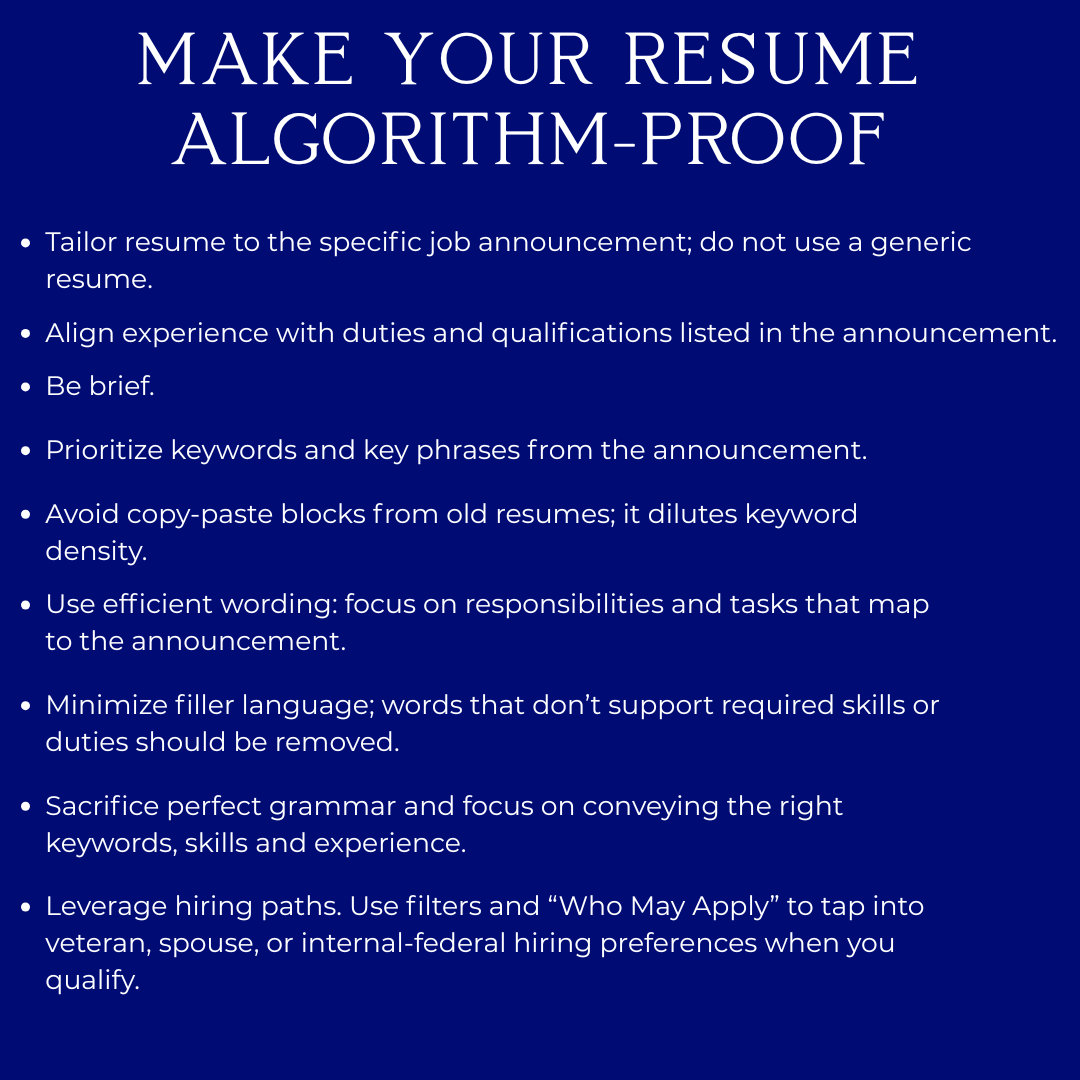
As of September 2025, federal agencies only accept resumes up to two pages in length to comply with the Merit Hiring Plan, according to the USA Jobs Help Center.
Clarke said with the shortened USA Jobs resume, applicants and federal employee hopefuls “… really, really have to look at keywords and phrases and make sure your experience is aligned against the job announcement.”
He said every resume submitted needs to be tailored to the announcement that is advertised.
“You just don’t have enough words anymore to do a bunch of copy-paste,” Clarke told Military Families Magazine. “I would argue getting the grammar correct is probably less important than summarizing the words that are important for somebody to understand — the responsibilities and tasks associated with a job.”
To understand how best to showcase themselves for a job, an applicant should understand how the department determined their need for the posted position.
“We contact CHRA [Civilian Human Resources Agency], we give them a position description, we explain that we want to create a hiring action, then they meet with us and they do what’s called an SRD, a strategic recruitment discussion,” Clarke said. “They ask a bunch of questions about what this job needs to do, and then they create from that strategic recruitment discussion, what they create is the announcement itself, which is a piece of the job description.”
Dawn Grimes keeps her eye out for series 1035 — public affairs — jobs. She’s landed three jobs through the federal employment site during her career, but remembers the day when she was frustrated because she wasn’t getting the referral indicating that her application passed initial screening, after submitting her application.
A friend told her she shouldn’t be afraid to call the number of whoever is assigned to that job and ask them. So, she did.
For Grimes at that time, it was a matter of submitting the incorrect paperwork. She submitted the Member 1 copy of her DD Form 214, or Discharge from Active Duty paperwork, as opposed to the required Member 4 copy.
“Not everybody’s going to answer, but if you have a question about why you weren’t referred, or if you can get some feedback about the package you submitted there, there is no harm,” she explained.
Grimes served 10 years in the Marine Corps before seeking federal service. She’s since reviewed resumes as part of the hiring processes for her offices.
“The ones that you really look at are the ones that definitely get your attention within the very first page, and the ones that are easy to read,” she said. “The normal things that are in the actual, real world apply, because ultimately, at the end of the day, the people who are looking at your resume are those same actual people, even though it’s a government job, it doesn’t matter. People are people.”