



“If you are sitting next to a child, be sure to put your mask on before assisting them with theirs.” We’ve all heard this admonition over the airplane speakers. We hope we’ll never have to find out what happens if we fail to follow instructions.
A recent study published by the Military Family Advisory Network (MFAN) captures exactly what happens when military spouses put their masks on last: military readiness is impacted.
‘PCS Delay Effect’
“In our data, we see that the currently serving and active-duty spouses are carrying a disproportionate amount of the load,” said MFAN Vice President of Research and Evaluation Dr. Gabby L’Esperance. “They’re establishing child care. They’re finding a job. They’re getting everyone settled, and there is delayed help-seeking for mental health care specifically.”






















The MFAN report calls this the PCS Delay Effect. It found that there is a “statistically significant relationship between how recently a respondent moved and their likelihood of seeking mental health support.”
Of the currently serving spouses who reported seeking mental health care (over 40%), 43.5% said military life-related challenges were the primary driver. And more than 25% of those who needed urgent care reported using the emergency room due to an inability to secure timely appointments.
The same pattern emerged when looking at employment: over 50% of spouses who had not moved in the past year were employed compared to 32% of those who had recently PCSed.
‘Moderate middle’
The report, entitled The Military Family 360°, both examined this invisible load and the military’s “moderate middle” — families who are not yet in crisis, but who are increasingly vulnerable to financial shocks, child care disruptions, spouse employment challenges, healthcare access barriers, and the rising costs associated with military life.
While 37.7% of the survey’s more than 10,000 respondents reported household incomes above $100,000 annually, MFAN researchers cautioned that income alone does not accurately capture financial vulnerability. Household size, geographic location, housing costs, and the realities of military mobility all influence whether a family is financially secure.
“Even for the group that are managing, that have made it to the moderate middle that might be moderate in their family health score or family wellbeing, are on a bubble that might pop,” said L’Esperance. “There is a vulnerability to that moderate middle status.”
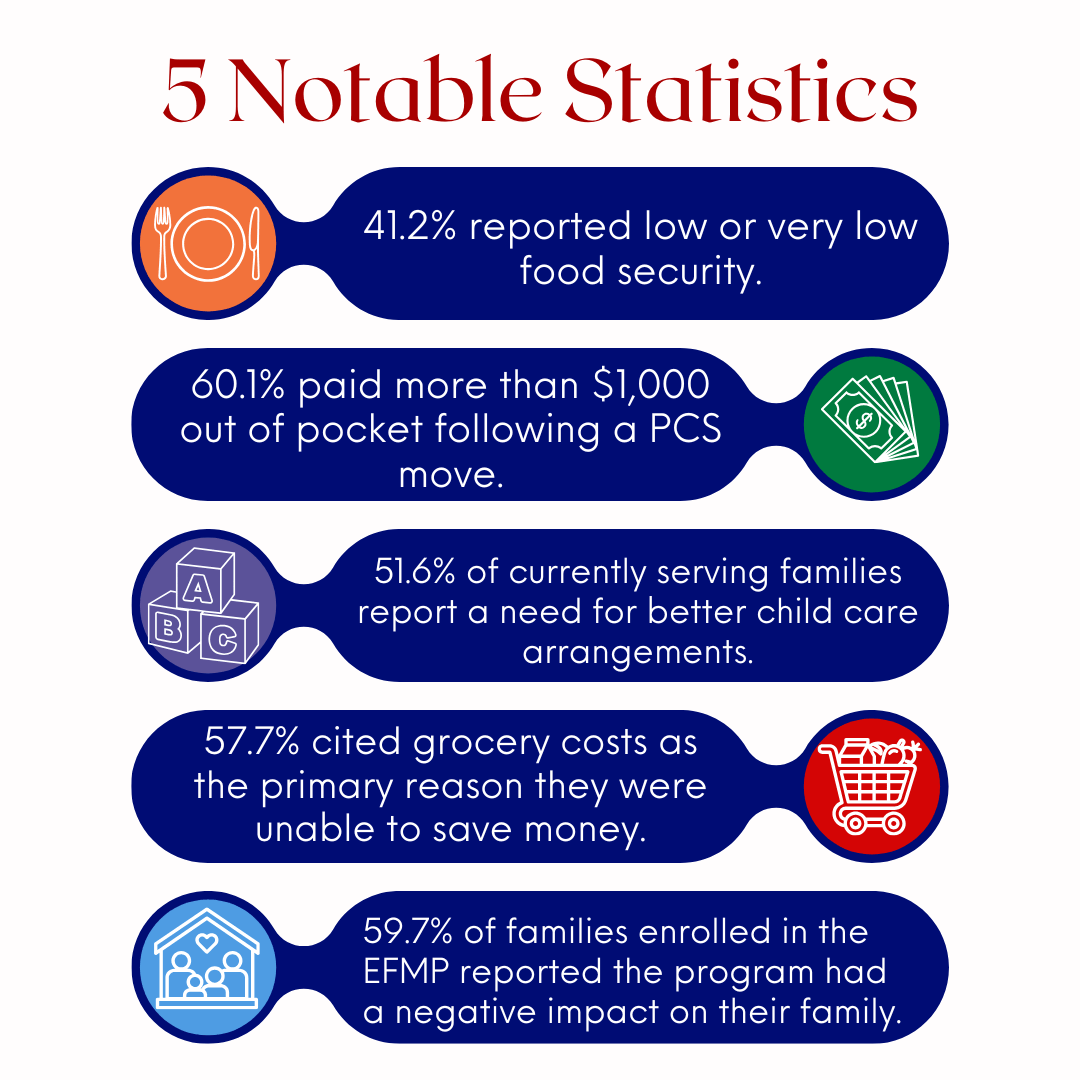
In fact, this vulnerability was documented throughout the report. More than a third of currently serving family respondents said they had less than $500 in an emergency savings fund, or no fund at all. Forty-one percent reported low or very low food security. Nearly half of enlisted respondents reported experiencing high or extreme financial stress.
According to the findings, when families are in financial stress, they may also experience food insecurity. Food insecurity, in turn, has a relationship with mental health and how families perceive military life.
While more than three-quarters of respondents reported that their experiences met or exceeded expectations, 51% of currently serving enlisted family respondents said financial stability fell below expectations, 70% of officer families identified spouse career opportunities as falling below expectations.
“Military family conditions are not the background to readiness, they are readiness,” said MFAN Associate Director of Research Dr. Shanna Smith during the presentation.
Reactions to the data
“MFAN’s survey data shows that military families, particularly those in the junior enlisted ranks, continue to struggle financially,” said Eileen Huck, director of government relations for National Military Family Association. “The statistics on food insecurity are especially sobering. It’s clear that more needs to be done to support military family financial well-being — it’s critical to military family readiness, retention, and ultimately our national security.”
“I hear from families all of the time that are very concerned about seeking mental health care because they homeschool,” said Natalie Mack, founder of Military Homeschoolers Association.
Mack said the families she works with share they are hesitant to seek help with their mental health as they don’t want practitioners to assume their homeschooling is the cause. This sentiment is shared by some Exceptional Family Member Program (EFMP) families who are asked about their own mental health in questions related to the Autism Care Demonstration.
Taking action
The 153-page report does not just feature data; it also includes recommendations for how the data can be acted upon, with treating spouse well-being as a national security priority as its first recommendation.
The data release concluded with a panel hosted by MFAN CEO Shannon Razsadin and featuring Deputy Assistant Secretary of War for Military Community and Family Policy Stephen Simmons; Fleet Master Chief David Isom, the Senior Enlisted Advisor to the Chairman of the Joint Chiefs of Staff; and retired Lt. Gen. Brian T. Kelly, president and chief executive officer of the Military Officers Association of America (MOAA). The group discussed how these findings will both impact their current understanding and future work.
At the conclusion, Razsadin asked the panel how they would take this information back to their day jobs.
Simmons replied, “I’m wondering if there isn’t a better way to measure family readiness, looking at family readiness as a readiness metric.”