


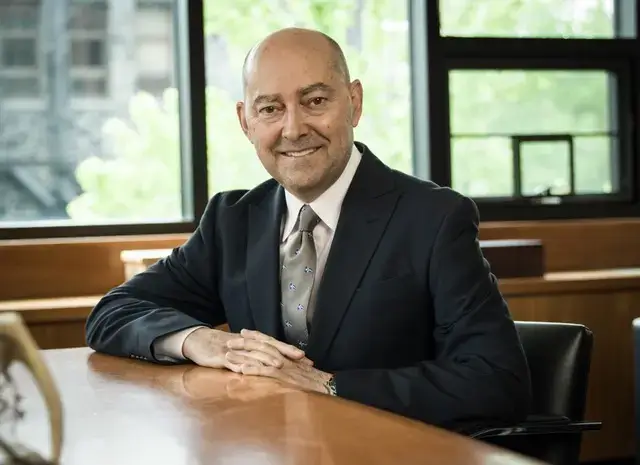
Over the course of his 37 years in the military and beyond, Adm. (ret.) James Stavridis has become well-known for many things: his service as Supreme Allied Commander at NATO; his appearances on CNN, where he breaks down the news as senior military analyst; being sanctioned by the Kremlin for his opposition to Vladimir Putin; and as a “New York Times” bestselling author, a designation he earned with the release of “2034,” a geopolitical military thriller imagining the fallout from a global war with China.
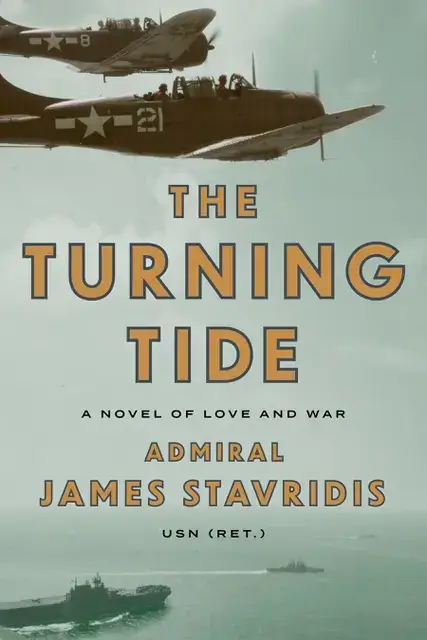
Stavridis’ latest novel, “The Turning Tide,” explores the complex realities of World War II through the eyes of hero Scott Bradley James, a young sailor amidst the maelstrom of the era’s significant events: Iwo Jima to Okinawa and the United States’ use of the atomic bomb. The novel is Stavridis’ latest exploration, too, of the myriad ways leadership shapes the course of history.
 “I’ve always been a writer,” Stavridis said in an interview with Military Families Magazine.
He served as the editor of The LOG at the U.S. Naval Academy, and published articles throughout his military career. He then turned to nonfiction and other naval topics, drawing on his decades of military life and leadership to write works such as “Destroyer Captain: Lessons from a First Command,” “Sea Power: The History and Geopolitics of the World’s Oceans,” and “Sailing True North: Ten Admirals and the Voyage of Character,” among many more.
Yet fiction allows him to explore the world in an often more immersive way.
“You’re not tied to the straitjacket of fact; you can really splash some paint around on the canvas of your book,” Stavridis said.
“The Turning Tide” is the second novel in a series, following “The Restless Wave.” The first book saw Scott Bradley James transition from a Naval Academy plebe to a sailor at Pearl Harbor and beyond in the early years of the world-shifting war. Like Stavridis’ other works, “The Turning Tide” draws heavily on his own experiences —particularly his time at sea as commander of a destroyer— as well as real-life historical leaders such as Adm. Chester Nimitz, who served as the U.S. Commander in Chief of the Pacific Fleet.
“His great skill was a kind of calm, almost serenity about him that allowed him to manage these mercurial personalities like Adm. Bill Halsey and others, and do so in a way that ultimately created victory in the Pacific,” Stavridis said. That sense of calm was one he strove to emulate in his own philosophy. “The essence of a leader, the mission of a leader, is to bring order out of chaos. I think that’s the kind of leader people need to be.”
Those lessons still echo through today’s world, one reason Stavridis was drawn to exploring World War II through fiction.
“Great power [and] competition hasn’t exploded into conflict yet, but certainly you can see that on the horizon,” he said. “We see alliances under stress. The U.S. and its alliances in World War II were difficult to manage and stressful, much like NATO today.”
He hopes the book inspires readers to think deeply about the world around them.
“We think of that World War II period, correctly, as one in which our nation was united, when we stood together, and I wanted to explore why that was because, let’s be honest, we are not so united today,” he said. “By looking back at that period of history, we can feel and explore what it’s like to be a united nation, and I think that’s a valuable kind of conversation for Americans to have in this very divided world we live in today.”
“I think people ultimately learn best when they’re told a story,” Stavridis said. “I hope Americans look at the book and think: that’s who we should be. We should be a nation that pulls together and tries to solve the big problems together.”
Stavridis’ latest book, “The Turning Tide,” is available wherever books are sold.
Read comments